
Numbers in Jewish tradition tell stories. We ask four questions at the Seder because four highlights the range of possibility, it embraces every type of child, every corner of human experience, every base covered. We recite 10 plagues because 10 signals that something entirely new is about to be born. 10 generations separated Adam from Noah, after which the world was remade. 10 more generations passed between Noah to Abraham, after which humanity's relationship with the Divine was remade. And we count seven days of the traditional Passover holiday, because seven means wholeness, completion, the creation story when the world fully arrived at itself.
Numbers are the Torah's quiet poetry, and they are worth reflecting on together.
Which brings us to 13. This Shabbat, we read of Gd's Thirteen Attributes of Mercy (Exodus 34:6-7), revealed to Moses after the shattering of the first tablets. Consider what 12 means before we reach 13: 12 months of the year, 12 mazalot (zodiac symbols), 12 tribes; the number of beautiful, elegant constraint. 12 is the architecture of order. But 13? 13 breaks the ceiling. 13 is boundless. 13 is what lives beyond every system, every limit, every cliff face where life seems to go no further.
The fact that Gd's mercy comes in 13 attributes is not coincidental. It is the Torah's way of whispering to all of us, collectively: Gd’s forgiveness has no floor and no ceiling. No matter how far we have wandered, as individuals, as a community, as a people, the 13 attributes reach further still.
And this is the deepest gift of Passover. It would be easy, even understandable, to carry the bitterness of our Master Story forward. Generations of slavery. Generations of tears baked into bricks. Yet we dip our finger into our wine for each plague, taking away from the satisfaction of a “full cup,” diminishing our joy, at the suffering of our oppressors. We do not celebrate their drowning. We look away, just like Lot was commanded to do when Sodom and Gomorrah were destroyed, from the wreckage and we walk.
There is a Hasidic story of a student who came to his Rebbe, ashamed over a mistake he had repeated, again. "How can Gd still forgive me?" he asked. "Surely I have exhausted my pleas." The Rebbe walked to the window and pointed to the river below. "How many times has that river flowed past this village?" The student answered: "Always." "And has it ever refused to flow because it flowed yesterday?" asked the Rebbe. Gd's mercy is not a finite reservoir that empties with use, he continued. It is a current. The 13 attributes are not 13 chances, they are 13 ways of saying: the water never stops flowing.
This is precisely why Passover does not ask us to forget. It asks us to move forward. The waves that washed over Pharaoh's army did not erase, they absorbed. The pain became part of something greater than itself. The Exodus was hard in its micro-moments, the desert offered little comfort, and the path forward was rarely clear. But the macro moments were luminous: a sea that split, a song that burst from Miriam's lips, a covenant renewed under open sky. The people were lean in resources but rich in direction.
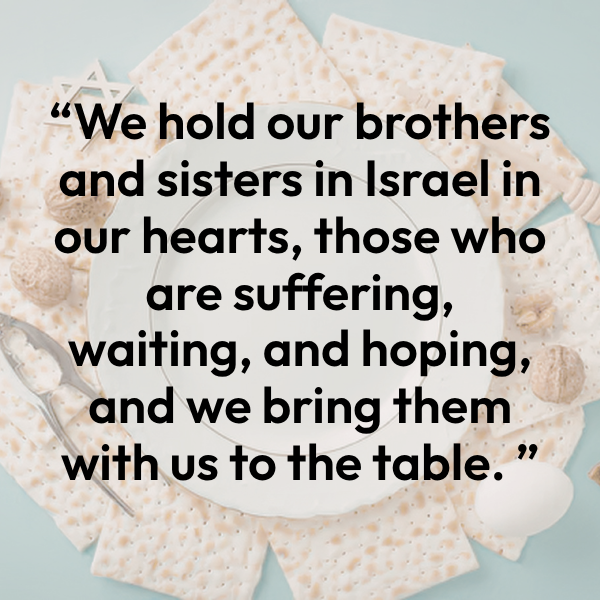
As a community, we carry that same duality today. We hold our brothers and sisters in Israel in our hearts, those who are suffering, waiting, and hoping, and we bring them with us to the table. We trust that the same boundless mercy that carried our ancestors through the wilderness is present still, flowing without condition, reaching without limit.
So here is our collective challenge this Passover: at some moment during your Seder, perhaps after the second cup, when the plagues have been named and your wine has been diminished, pause and name, aloud or silently, one grievance you are choosing to release this year. Not forget. Not pretend never happened. But release, to let the wave carry it into something larger than the pain. And then name one hope, one tikvah, you are carrying forward. For yourself. For your family. For our people.
The Seder already asks us to feel as though we personally left Egypt. This year, let us take that a step further and actually leave something behind at the table. Let us bring something new with us from the gathering. Because we are Stronger Together.
Chag sameach, and an early Shabbat Shalom,
|
|