
The third book of the Torah opens with a grammatical curiosity that the rabbis could not ignore. "Vayikra el Moshe vayedaber Hashem eilav" ("And Gd called to Moses, and Gd spoke to him.") Vayikra 1:1. Two verbs. One right after the other. Called. Then spoke. Why the redundancy? If Gd was going to speak, why first call? And if Gd called, isn't that itself a form of speaking?
To be called is to be summoned by name. It is the outreach, the hand extended across a room, the hug offered from a distance, the recognition that says: you belong here, you matter, you are seen. A calling is not a job description. It is an identity. It is the answer to the question, why are you here at all?
To be spoken to is something altogether different. It is direct. Granular. Specific. It addresses not your presence, but your actions. Not who you are, but what you must now do. Gd called Moses first, affirming his belovedness, and only then spoke the detailed laws of sacrifice, purity, and obligation. First the embrace. Then the ask.
We all receive a calling. But not all of us are lucky enough to have someone who will then speak to us, who will walk with us through the hard, specific, uncomfortable details of actually living it out.
There is a parable of two study partners in chavurah (didactic dialogue) who disagreed about nearly everything. One was methodical, the other intuitive. One demanded sources, the other demanded meaning. They argued constantly, and more than once considered parting ways. But years later, when each was asked who had shaped them most profoundly, both named the other.
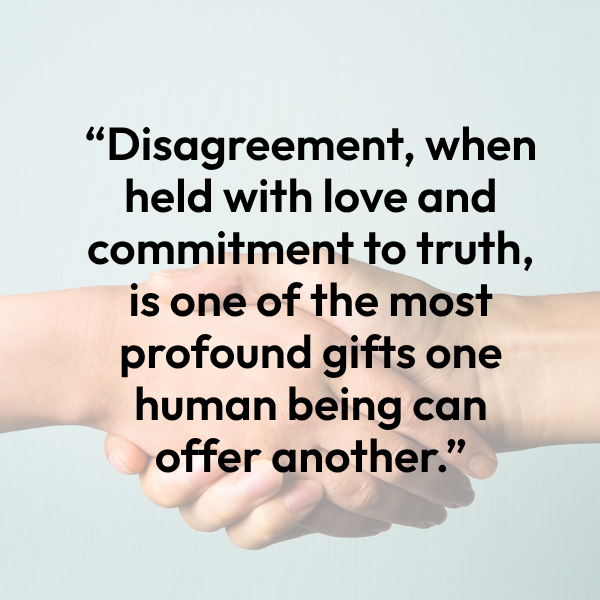
Because it was precisely in the friction, in being pushed to defend what they assumed they knew, in being forced to consider what they had reflexively dismissed, that real learning happened. The one who challenges us, who makes us uncomfortable, who holds up a mirror to our assumptions, is often doing more speaking to us than those who simply affirm us. Disagreement, when held with love and commitment to truth, is one of the most profound gifts one human being can offer another.
This is Torah's wisdom about relationship: we need both. We need to be called, welcomed, embraced, seen. And we need to be spoken to, challenged, directed, and held accountable.
Look at the world right now, and it is almost impossible to hold these two things together.
In Israel, our extended family is living with the rhythm of sirens and shelter. A grandmother in Netanya interrupted mid-sentence by an alert. Children in the south whose "normal" is defined by how quickly they can reach a safe room. And yet Israeli society is not simply surviving. It is debating. Dreaming. Arguing about the future even as the present explodes around it. The calling of the Jewish people, am Yisrael, a nation with a purpose, persists even when the speaking, the daily details of that purpose, is drowned in the noise of war.
For us here in the United States, the distance is both a mercy and a moral hazard. We feel the war at the gas pump. We watch it in our investment portfolios. We hear it in hushed conversations with cousins and nephews in Tel Aviv. We are called, by blood, by history, by covenant, to care. But are we being spoken to? Are we translating that calling into action? Into presence? Into something more than worry?
The Vayikra question presses on us: Gd did not stop at the calling. Neither can we.
So, here is the ask, simple, and not simple at all.
Reach out this week to someone you haven't spoken to in a long time. Better yet, reach out to someone with whom you've had distance not just of time, but of disagreement. A family member on the other side of a political divide. A former friend whose choices you didn't understand. A neighbor you've passed a hundred times without stopping.
You don't have to resolve everything. You don't have to agree. You only have to call, to extend the hand that says: you are seen, you matter, you belong in my world.
And then, if you are brave, stay long enough to be spoken to, to hear something that challenges you, that pushes past your comfort, that might even change you.
This is what building Jewish community means. This is what the work of kehillah, of the Jewish Federation, is rooted in: the belief that the calling is not enough without the speaking, and that neither is possible without showing up for one another.
The world is dark in ways that feel overwhelming. But our tradition does not ask us to fix everything. It asks us to lower the temperature where we stand. To push back the darkness with whatever light we can carry. Moment by moment. Conversation by conversation. Relationship by relationship.
Vayikra (and Gd called). The book begins with an invitation. The rest is up to us.
Because we are Stronger Together.
Shabbat Shalom,
|

|