
This week's Torah portion grants Pinchas (Aaron’s grandson) an unusual reward. After Pinchas acts alone, decisively, violently, to stop a plague of moral collapse, Gd does not simply commend him, Gd gives him a brit shalom, a covenant of peace (Numbers 25:12). The pairing is jarring. Why does the man who just wielded a spear in violent action receive, of all things, peace?
The rabbis wrestle with this very question. Some read it as simple reward, zealotry answered with blessing. But the Netziv (Rabbi Naftali Tzvi Yehuda Berlin) offers something sharper: he suggests Gd worried that an act like Pinchas's could calcify into character, that a man capable of righteous violence might become, permanently, a violent man. The covenant of peace wasn't a medal. It was a corrective. It was Gd saying: let this act not become who you are. Peace, in this reading, isn't the absence of struggle, it's what keeps conviction from curdling into cruelty.
Simon Wiesenthal understood this tension better than most. After liberation, Wiesenthal refused an invitation to pray, disillusioned by an incident that occurred during his time in the camp where one man traded a smuggled siddur for the last bread of starving prisoners. However, a rabbi corrected Wiesenthal by pointing him not to the one prisoner’s corruption, but to the many who gave up their only food for a few minutes with Gd. Wiesenthal could have taken the easier path: dismiss it all, walk away from the inner struggle of faith, protect himself by disengaging from his Jewish identity altogether. That would have looked like peace.
Instead, Wiesenthal spent his life inside the harder truth, chasing Nazi war criminals not for revenge but for righteousness. "Justice, not vengeance" was Wiesenthal’s creed. He knew that vengeance offers false peace, quick and hollow. Real peace, Pinchas's peace, Wiesenthal's peace, comes only from clarity of purpose, from knowing precisely why we act.
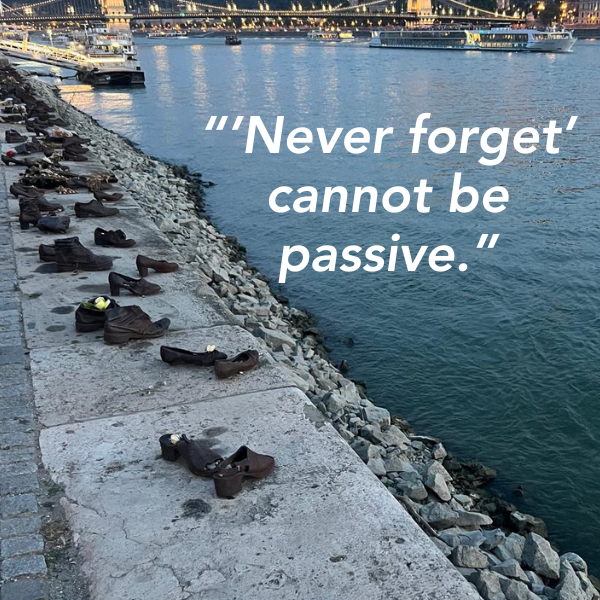
The Jewish Federation of Greater Naples just concluded a mission to Poland, 42 of us walking ground soaked in memory. Yet today, in a moment when anti-Semitism and anti-Zionism blur into one indistinguishable threat, the pull toward retribution is real and understandable. However, as Jews, our covenant of peace demands more than private memory held quietly inside us. "Never forget" cannot be passive. We are not just keepers of memory; we are its active voice. We come home not only to remember, but to keep telling, keep testifying, keep choosing justice over vengeance, because that, and only that, is where peace actually lives.
Today, I know that I would never have had the same experience if I had come to these places alone. I might have learned the facts, heard the stories, and read the signage. But I would have never experienced the peace without my community at my side. Thank you to all the travelers who joined on this journey. Because we are Stronger Together.
Shabbat Shalom.
|

|